
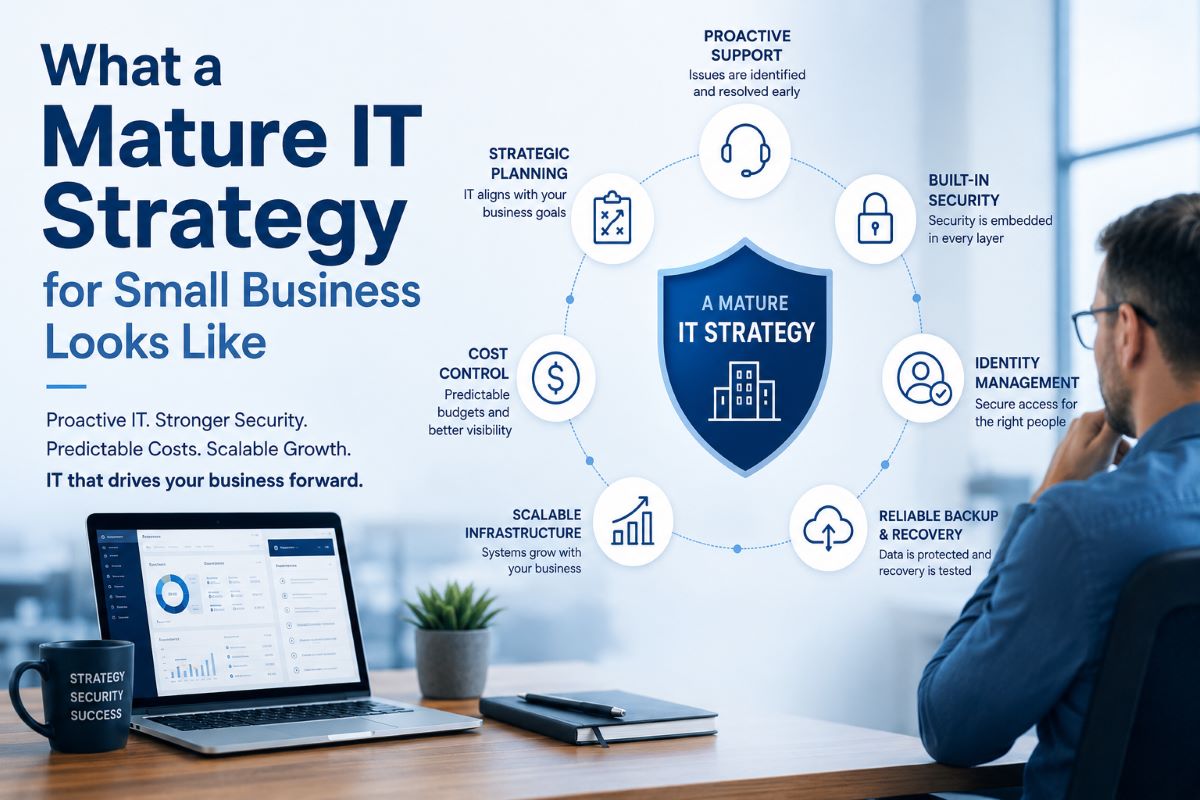
A mature IT strategy for small business is what separates companies that constantly fight IT issues from those that scale smoothly, securely, and predictably. In a mature IT strategy for small business, technology is managed proactively, and IT becomes a structured business function rather than a reactive support service. As a result, businesses reduce downtime, improve security, and support growth more effectively. In addition, they gain better control over costs and reduce operational risk.
In a mature IT strategy for small business, teams manage IT as a complete system instead of a collection of disconnected tools. For example, companies standardize devices, applications, and configurations across the organization.
As a result, employees experience fewer inconsistencies, and IT teams resolve issues faster. In addition, organizations create clear lifecycle rules for hardware and software, which reduces waste and improves planning.
Meanwhile, businesses eliminate “one-off” setups that often lead to hidden technical debt.
In a mature IT strategy for small business, security is not an afterthought. Instead, IT teams build security into every system from the start.
For example, companies enforce multi-factor authentication across all applications. In addition, they apply least-privilege access so employees only access the systems they need.
As a result, organizations reduce the likelihood of breaches and limit the impact of compromised accounts. Furthermore, teams continuously monitor systems and apply patches on a regular schedule rather than reacting to incidents.
A key part of a mature IT strategy for small business is the shift from break/fix support to proactive management. Instead of waiting for issues to occur, IT teams monitor systems continuously.
For instance, modern support systems detect performance issues before users notice them. In addition, automated alerts trigger immediate responses when risks appear.
Because of this proactive approach, businesses reduce downtime and improve employee productivity. Meanwhile, recurring issues are identified and eliminated at the root cause.
In a mature IT strategy for small business, identity replaces the traditional network perimeter. Therefore, controlling user access becomes the most important security function.
IT teams centralize identity management and enforce single sign-on across applications. In addition, they automate onboarding and offboarding processes to ensure access is always accurate.
As a result, businesses reduce the risk of unauthorized access and eliminate orphaned accounts that often create security vulnerabilities.
A mature IT strategy for small business also improves financial predictability. Instead of reacting to emergencies, companies plan IT spending in advance.
For example, businesses adopt lifecycle-based hardware replacement schedules. In addition, they use managed service models to stabilize monthly IT costs.
As a result, organizations avoid unexpected expenses and reduce financial volatility. Furthermore, leadership gains clearer visibility into long-term IT investments.
In immature environments, IT support often scales by adding more staff. However, in a mature IT strategy for small business, organizations avoid linear hiring growth.
Instead, teams use automation, standardized processes, and managed service partnerships. For example, automated provisioning reduces manual onboarding tasks.
As a result, companies support more employees without significantly increasing IT headcount. Meanwhile, IT teams focus on higher-value strategic work instead of repetitive tasks.
In a mature IT strategy for small business, data protection is not assumed, it is verified. Therefore, companies automate backups and test recovery regularly.
For instance, IT teams define recovery time objectives and recovery point objectives for critical systems. In addition, they run regular restore tests to ensure backups function correctly.
As a result, businesses recover faster from disruptions and reduce the risk of permanent data loss. Furthermore, leadership gains confidence in business continuity planning.
A mature IT strategy for small business includes long-term planning rather than short-term fixes. Therefore, IT teams develop roadmaps that align with business goals.
For example, companies plan infrastructure upgrades over 12 to 36 months. In addition, they evaluate new tools based on integration, security, and scalability, not just immediate need.
As a result, organizations reduce technical debt and avoid repeated system overhauls. Meanwhile, IT becomes a driver of business growth instead of a constraint.
In a mature IT strategy for small business, support systems do more than resolve tickets. Instead, they generate insights that improve the entire environment.
For example, IT teams analyze recurring issues to identify root causes. In addition, they use support trends to improve documentation and training.
As a result, businesses reduce repeat problems and increase operational efficiency. Furthermore, employees experience fewer disruptions over time.
Ultimately, a mature IT strategy for small business aligns technology decisions with business outcomes. Therefore, IT success is measured by business impact, not just technical metrics.
For example, organizations measure productivity improvements, reduced downtime, and improved security posture. In addition, they evaluate how quickly they can onboard new employees or scale operations.
As a result, IT becomes a strategic advantage rather than a cost center.
A mature IT strategy for small business transforms IT from a reactive function into a structured, proactive, and scalable business system. In addition, it improves security, stabilizes costs, and enables growth without unnecessary complexity.
For companies working with providers like Datotel, this maturity model represents the shift from simply “keeping systems running” to building an IT environment that actively supports long-term business success.