
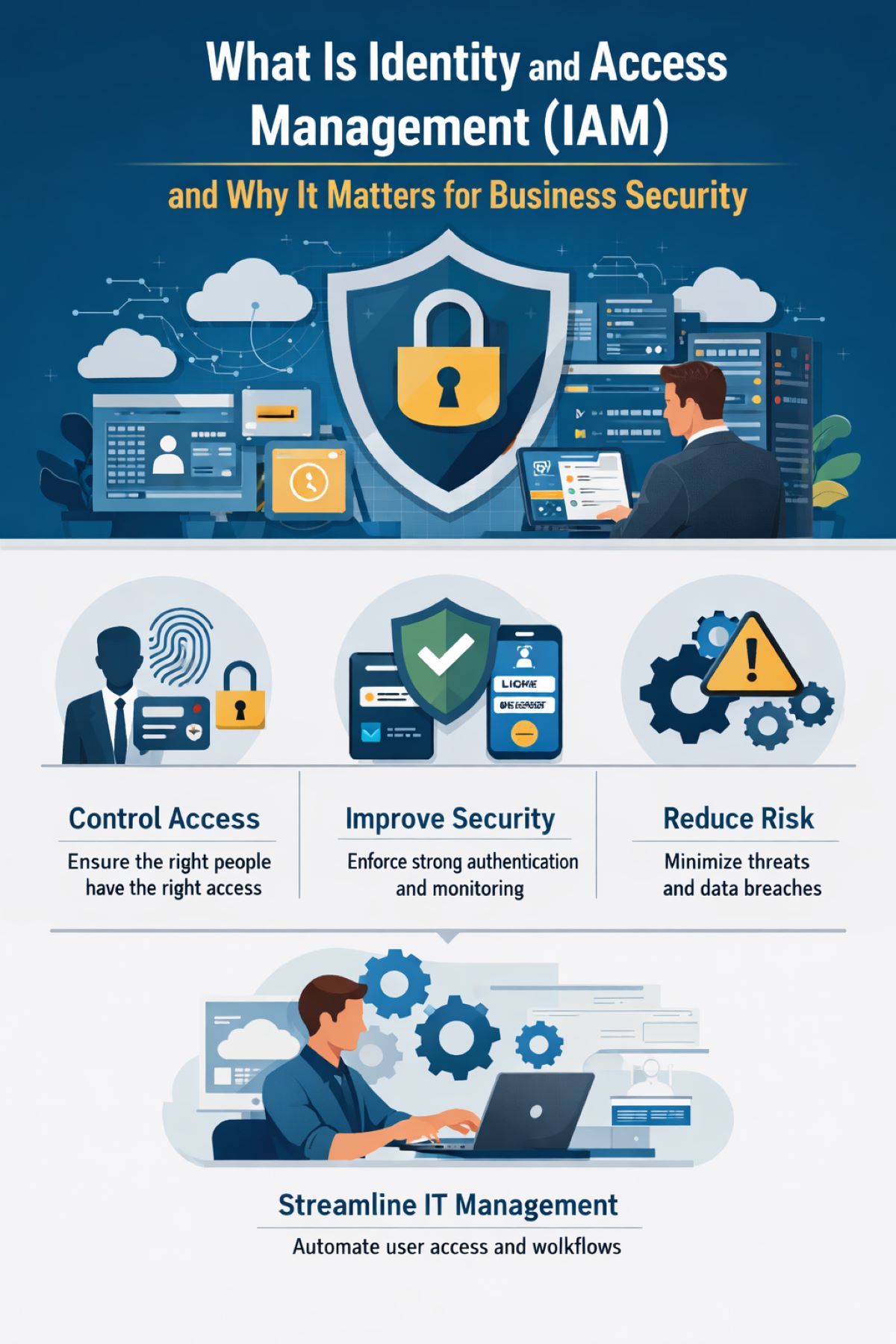
What is identity and access management (IAM), and why is it so important for modern businesses?
As organizations adopt cloud applications, remote work environments, and digital tools, they face increasing complexity in managing access to systems. Identity and Access Management (IAM) helps businesses control who can access their systems, what they can access, and how they manage that access over time.
For business leaders, IAM is not just a technical concept. It plays a critical role in cybersecurity, compliance, and operational efficiency. When organizations understand how IAM works, they can reduce risk, improve productivity, and support long-term growth.
Identity and Access Management (IAM) uses policies, processes, and technologies to ensure the right individuals gain the right access to the right resources at the right time.
In simple terms, IAM controls how organizations identify users and manage their access to systems. Every employee, contractor, and partner has a digital identity, and IAM verifies that identity while enforcing access rules based on roles and responsibilities.
Instead of managing access manually across multiple systems, IAM centralizes control. This allows organizations to apply consistent security policies across all applications, devices, and environments.
IAM also manages user access throughout its entire lifecycle. It handles onboarding, role changes, and offboarding while maintaining visibility and control at every stage.
IAM combines several processes that control and monitor access within an organization.
First, the system authenticates users by verifying their identity. It may use passwords, multi-factor authentication, or other security methods to confirm who the user is.
After authentication, the system authorizes users by determining what they can access. This ensures each user only receives permissions required for their role.
IAM continuously manages identities and permissions behind the scenes. It updates access automatically when employees change roles and removes access when they leave the organization.
Together, these processes create a secure environment where organizations control and monitor access in real time.
Today, identity serves as the primary entry point for many cyber threats. Attackers often target compromised credentials instead of directly attacking systems.
IAM helps businesses reduce this risk by enforcing strong access controls. It limits access to only what users need and strengthens authentication methods.
IAM also improves visibility. Organizations can track who accesses systems and how they interact with data. This makes it easier to detect unusual or suspicious activity.
Without IAM, businesses face higher risks of data breaches, compliance issues, and operational disruptions.
IAM reduces business risk in several key ways.
It enforces the principle of least privilege, which ensures users only receive the minimum access required to perform their jobs. This limits potential damage if an account becomes compromised.
IAM also strengthens security through multi-factor authentication. Even if someone steals a password, they cannot access systems without completing additional verification steps.
In addition, IAM monitors user behavior. It identifies unusual activity and alerts administrators so they can respond quickly to potential threats.
IAM also protects organizations during employee turnover. When someone leaves, the system immediately removes their access across all systems, preventing unauthorized access through unused accounts.
IAM significantly reduces the workload for IT teams.
In traditional systems, IT staff manually create accounts, assign permissions, update access, and remove users. These tasks take time and can lead to errors.
IAM automates these processes. When a new employee joins, the system automatically grants access based on their role. This allows them to start working immediately without delays.
When an employee changes roles, IAM updates their permissions automatically. This keeps access aligned with their responsibilities.
When someone leaves the organization, IAM removes all access right away. This eliminates security risks and prevents forgotten accounts from remaining active.
By automating these tasks, IAM frees IT teams to focus on more strategic work.
IAM delivers several important benefits:
Traditional access management relies on manual processes. IT teams manage permissions across systems individually, which often leads to inconsistencies and errors.
IAM replaces this approach with a centralized system. Organizations manage access from a single platform, which improves accuracy and ensures consistent policy enforcement.
This centralized model also improves visibility, making it easier to monitor activity and maintain security.
Implementing IAM requires careful planning and ongoing management. Many organizations work with experienced IT partners to build effective IAM strategies.
Datotel helps businesses design and manage IAM solutions that align with their security and operational needs. With technical expertise and a strong understanding of business environments, Datotel supports organizations in building secure and efficient access systems.
For businesses seeking trusted St. Louis IT consulting, Datotel provides guidance that simplifies identity management while strengthening security.
Understanding identity and access management is essential for any organization operating in today’s digital environment.
IAM gives businesses the tools to control access, reduce security risks, and improve efficiency. It helps protect data, streamline IT processes, and maintain visibility across systems.
For business leaders, IAM is not just an IT solution, it is a foundational part of building a secure, scalable, and resilient organization.
Contact us today to get started on implementing IAM in your environment.