
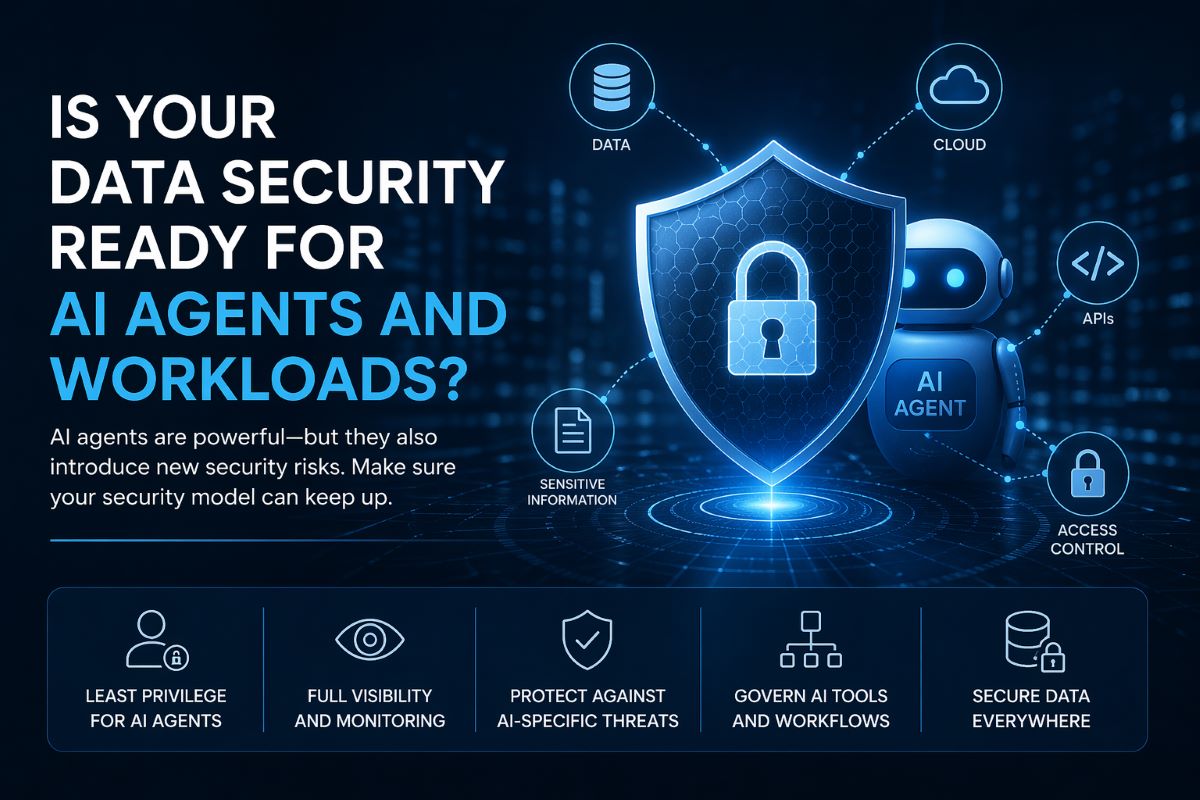
AI is no longer just a set of tools organizations experiment with, it is becoming an active participant in business operations, with direct access to sensitive systems and data.
As a result, AI agent security risks are quickly emerging as one of the most important challenges for enterprise security teams today.
From autonomous AI agents handling customer interactions to models making real-time infrastructure decisions, AI is now both a consumer and producer of sensitive data. In many environments, however, it operates with far less oversight than traditional applications.
At Datotel, we’re seeing a clear shift: the question is no longer “Are you using AI?” but instead “Can your security model safely govern systems that act on your data autonomously?”
And for many organizations, unfortunately, the answer is not yet.
Traditionally, applications are deterministic. In other words, they follow defined inputs, outputs, and permission structures.
However, AI agents are fundamentally different:
Therefore, this represents a shift from deterministic systems to probabilistic, autonomous ones.
As a result, AI agent security risks are not just an extension of existing cybersecurity problems, they represent a new class of operational risk.
Enterprises are therefore no longer securing static application flows. Instead, they are securing dynamic systems that actively make decisions and interact with sensitive data.
1. Over-Permissioned AI Access (Identity & Authorization Risk)
First, AI agents often require broad access to function effectively. Without strict controls, however, organizations quickly drift into over-permissioned environments where AI systems can access far more data than necessary.
In addition, unlike traditional users, AI agents operate continuously, at scale, and across systems. Therefore, enforcing least-privilege access controls becomes significantly more complex.
2. Prompt Injection and Behavioral Manipulation
In addition, AI systems introduce an entirely new class of attack surface: natural language inputs.
For example, adversaries can manipulate model behavior through carefully crafted prompts, which may lead to:
Consequently, language itself becomes an attack vector.
3. Lack of Visibility into AI-Driven Data Flows
Meanwhile, AI workflows frequently move data across:
However, without unified observability, organizations lose track of where sensitive data is accessed, transformed, or exposed.
Therefore, this is no longer just a logging problem, it is a full data lineage and governance challenge.
4. Shadow AI and Uncontrolled Adoption
At the same time, business units are increasingly deploying AI tools independently of central IT and security governance.
As a result, this creates fragmented, unmonitored systems that bypass:
Consequently, shadow AI is now one of the fastest-growing enterprise blind spots.
5. Data Exposure Through Training and Retrieval Pipelines
Finally, large language models and retrieval-augmented systems introduce additional risk when exposed to unfiltered or improperly segmented data.
For instance, sensitive information can unintentionally surface through:
Without proper segmentation, therefore, AI systems can become inadvertent exposure channels.
6. Local AI Agents and Privilege Inheritance
AI agents installed on endpoints introduce a particularly sensitive risk: they often inherit the full permissions of the logged-in user.
As a result, these agents may gain unintended access to:
Unlike traditional software, these agents operate with human-level privileges but without human-level intent awareness or decision boundaries.
Consequently, this creates a form of implicit privilege escalation, where the AI agent can access and act on data the user never explicitly intended to expose.
Before scaling AI agents or workloads, IT and security leaders should evaluate:
1. Can you enforce least privilege for non-human identities (AI agents)?
Not just users, but autonomous systems that act independently.
2. Can you trace every AI-driven data access event end-to-end?
In other words, across all systems, not just individual logs.
3. Can you detect and block prompt injection attempts in real time?
4. Do you have governance over unsanctioned AI tools and integrations?
If not, shadow AI may already be present in your environment.
5. Is sensitive data excluded from AI training and retrieval pipelines by design?
Modern AI security is not about restricting innovation. Instead, it is about enabling it safely at scale.
At Datotel, we see this as both a security and infrastructure challenge. In particular, identity, networking, and data governance must converge to support AI adoption without expanding risk exposure.
Therefore, key strategies include:
Ultimately, security must evolve from static perimeter defense to dynamic, behavior-aware governance.
AI agents are becoming deeply embedded in enterprise operations. While powerful, they introduce a fundamentally new risk landscape.
Organizations that treat AI as just another application layer risk underestimating AI agent security risks, including autonomy, scale, and uncontrolled data interaction.
The better question to ask today is:
Can your security model govern systems that act on your data autonomously, not just systems that store and transmit it?
If your organization is evaluating AI adoption, Datotel can help you assess and strengthen your infrastructure against emerging AI agent security risks. Contact us to start the conversation.