
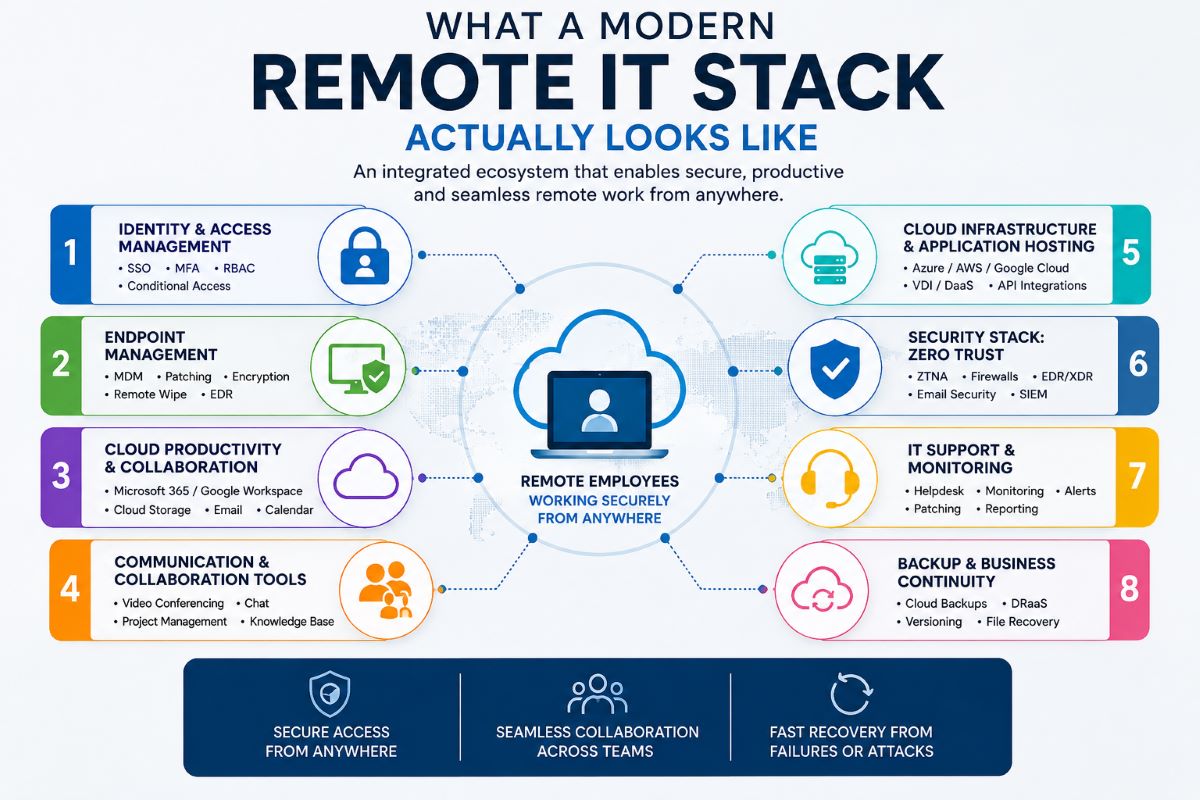
Remote work is no longer a temporary adjustment, and instead, it has become a standard operating model for many organizations. While employees may see it simply as “logging in from anywhere,” what actually makes it work behind the scenes is a carefully designed modern remote IT stack.
In other words, a modern remote IT stack is not just a convenience, it is the foundation that enables secure and efficient distributed work. Without it, remote operations quickly become fragmented and insecure.
A modern remote IT stack is not a single tool or platform. Rather, it is an integrated ecosystem of identity, security, communication, cloud infrastructure, and support systems that enables employees to work securely and efficiently from anywhere.
Below is what that stack actually looks like in practice.
In a remote environment, identity becomes the primary security boundary. Instead of protecting a physical office network, organizations must verify every user and device attempting to access systems.
Therefore, a modern identity layer typically includes:
As a result, even if credentials are compromised, access to systems remains tightly controlled.
Every laptop, tablet, and mobile device becomes a potential entry point into the organization. Because of this, endpoint management is a critical control layer.
A modern endpoint strategy includes:
In turn, this ensures that devices remain secure, compliant, and continuously monitored, regardless of location.
This is the layer most employees interact with daily. In fact, it replaces traditional on-premise file servers and desktop-bound productivity tools.
Core components typically include:
As a result, this shift eliminates the need for VPN-based file access in many environments and improves both accessibility and scalability.
Remote work depends heavily on clear, structured, and consistent communication. Without it, productivity quickly degrades.
Therefore, a modern communication stack includes:
However, the key is not just adopting tools, but standardizing how and when they are used to avoid fragmentation and information silos.
Beyond productivity tools, most organizations rely on business-critical applications that must remain accessible in a remote-first environment.
Accordingly, modern approaches include:
This reduces dependency on physical servers and, in turn, enables scalable, location-independent access to core business systems.
Security in a modern remote IT stack is no longer perimeter-based. Instead, it follows a Zero Trust model of “never trust, always verify.”
Consequently, key components include:
The goal, therefore, is continuous verification of users, devices, and behavior, not one-time authentication.
Even the most advanced systems fail without effective support. In addition, remote work increases the importance of fast, responsive IT services.
A modern support layer typically includes:
As a result, managed IT service providers often become essential to maintaining uptime and productivity across distributed teams.
Remote work does not eliminate the need for data protection, in fact, it expands it across more systems and endpoints.
Therefore, a modern backup and recovery strategy includes:
This ensures that organizations can recover quickly from ransomware, accidental deletion, or service outages.
Ultimately, a modern remote IT stack is not simply a collection of tools, it is a coordinated architecture designed around three core objectives:
When these layers are properly integrated, remote work becomes not just possible, but also efficient, scalable, and resilient.
Finally, for many organizations, building and maintaining this environment internally can be complex. This is why businesses often partner with managed IT providers like Datotel to design, secure, and support their remote infrastructure end-to-end.
Call us today to start the journey.