
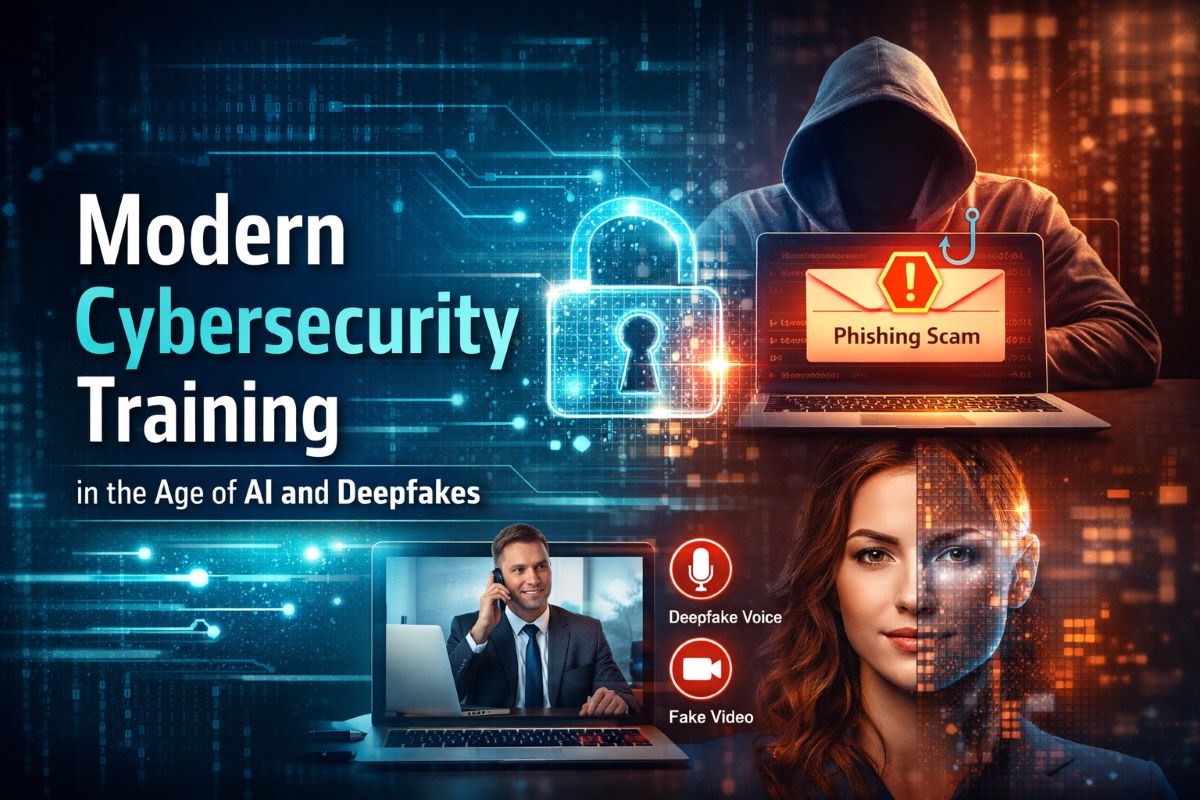
Artificial intelligence has permanently changed the threat landscape. As a result, what once required skilled cybercriminals, time, and effort can now be generated in seconds, at scale, with frightening accuracy. AI-driven phishing, voice deepfakes, and synthetic identities are no longer emerging threats, they are active tools being used against organizations of every size.
Therefore, in this new reality, modern cybersecurity training must evolve. Traditional, annual programs are no longer enough to defend against attacks that look, sound, and behave like legitimate communications.
Social engineering has always relied on deception, urgency, and trust. However, AI simply removes the friction.
From Poor Grammar to Perfect Personalization
Older phishing emails were easier to spot:
For example, AI-generated phishing emails now:
Moreover, attackers can scrape public data, LinkedIn profiles, breached credentials, and social media content to craft highly targeted, convincing messages in seconds.
Deepfake technology has moved from novelty to weapon. Consequently, organizations face new types of threats.
Common Deepfake-Enabled Attacks:
In particular, finance teams and executives are especially vulnerable. A single convincing voice call requesting an “urgent wire transfer” can bypass even experienced staff if proper verification processes are not in place.
Many organizations still rely on:
However, this approach fails because AI attacks evolve faster than static training content.
Key Gaps in Legacy Training:
In other words, attackers train continuously. Therefore, your employees must too.
To defend against AI-powered attacks, training programs must shift from knowledge-based to behavior-based.
1. Realistic, AI-Inspired Phishing Simulations
Employees need exposure to:
Fortunately, platforms like Proofpoint allow organizations to simulate these attacks safely, before real attackers do.
2. Continuous Training, Not Annual Events
AI threats don’t operate on a yearly schedule. As such, effective programs use:
This approach builds muscle memory, not just awareness, which is the core principle behind modern cybersecurity training.
3. Emphasis on Verification, Not Detection Alone
In a deepfake world, employees must assume:
“This could be fake, even if it looks real.”
Therefore, training should reinforce:
Ultimately, security awareness is no longer about spotting “bad emails.” It’s about making safe decisions under pressure.
Training tells you what employees should do. However, testing shows what they actually do.
Metrics That Matter in the AI Era:
Without testing, organizations operate on false confidence, a dangerous position when facing AI-driven attacks.
Organizations that fail to modernize awareness programs face:
In fact, most breaches still begin with a human decision. AI simply makes that decision harder.
In the age of AI and deepfakes:
Consequently, modern cybersecurity training is no longer just an IT function. It is a core business risk management strategy.
Attackers are already using AI to manipulate trust. Organizations that rely on outdated training models will fall behind, fast.
Therefore, modern security awareness programs that combine realistic training, continuous testing, and actionable metrics are no longer optional. They are essential to surviving the next generation of cyber threats. Learn how Datotel’s Security Awareness Training can help your team stay protected.