
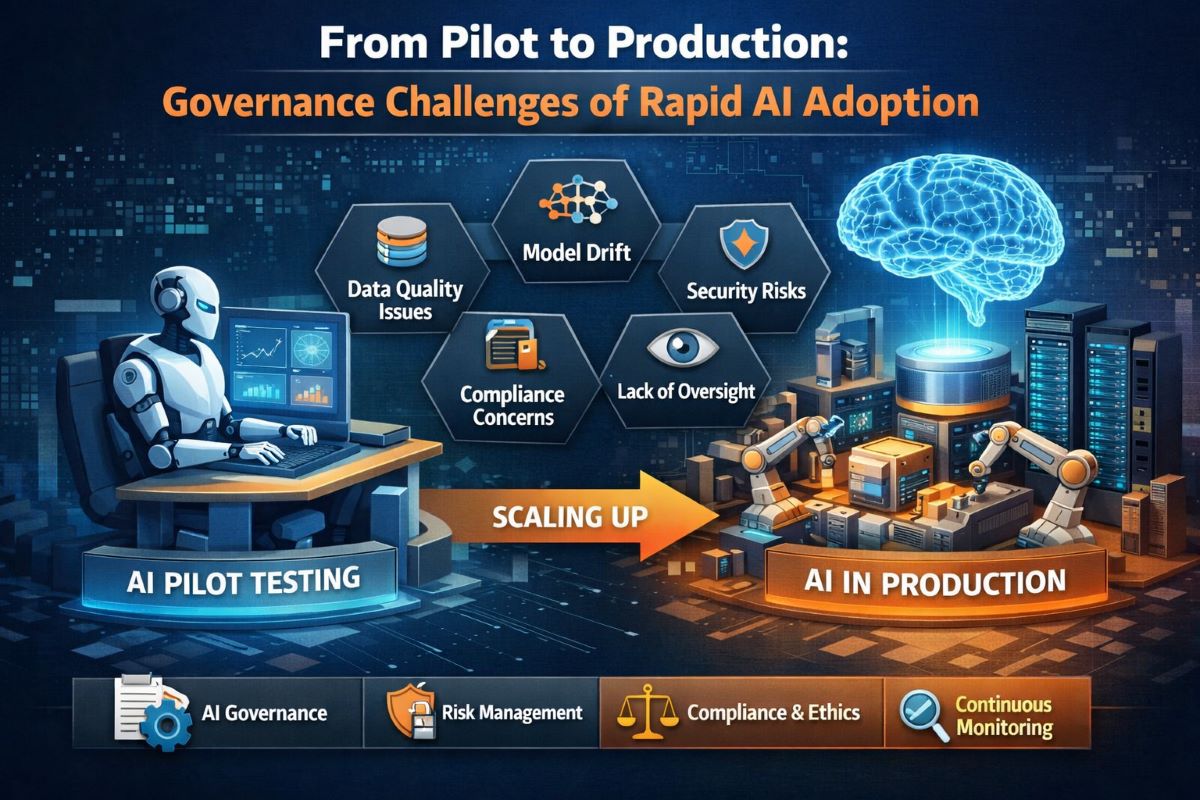
Artificial intelligence is no longer confined to research labs or controlled pilot programs. Businesses across industries are rapidly adopting AI, and establishing strong AI governance for production environments is critical to ensure these projects are safe complain and effective. However, rapid adoption comes with risk. Many organizations struggle to implement proper governance, resulting in security, compliance, and operational challenges.
Organizations are experimenting with AI in finance, HR, marketing, IT, and customer support. Pilots often show promising results, streamlining workflows, automating decisions, and uncovering new insights. However, what works in a test environment can become risky when scaled. Without proper oversight, AI models may produce unintended consequences, including bias, errors, and security vulnerabilities.
Transitioning AI from pilot to production introduces multiple challenges:
AI governance for production is complex because business units often deploy AI independently. Common challenges include:
To safely scale AI, organizations should implement robust governance practices:
Managed IT services providers like Datotel play a crucial role in bridging the gap between rapid AI adoption and effective governance. Key services include:
By leveraging expert IT oversight, organizations can accelerate AI adoption while reducing risk and ensuring compliance.
The rapid transition from AI pilots to production offers enormous potential but also significant challenges. By prioritizing AI governance for production, continuous monitoring, and accountability, organizations can harness AI safely and effectively. Partnering with an experienced IT provider ensures that AI initiatives are secure, compliant, and aligned with business goals. Ultimately, strong governance transforms AI from a pilot experiment into a reliable production asset.