
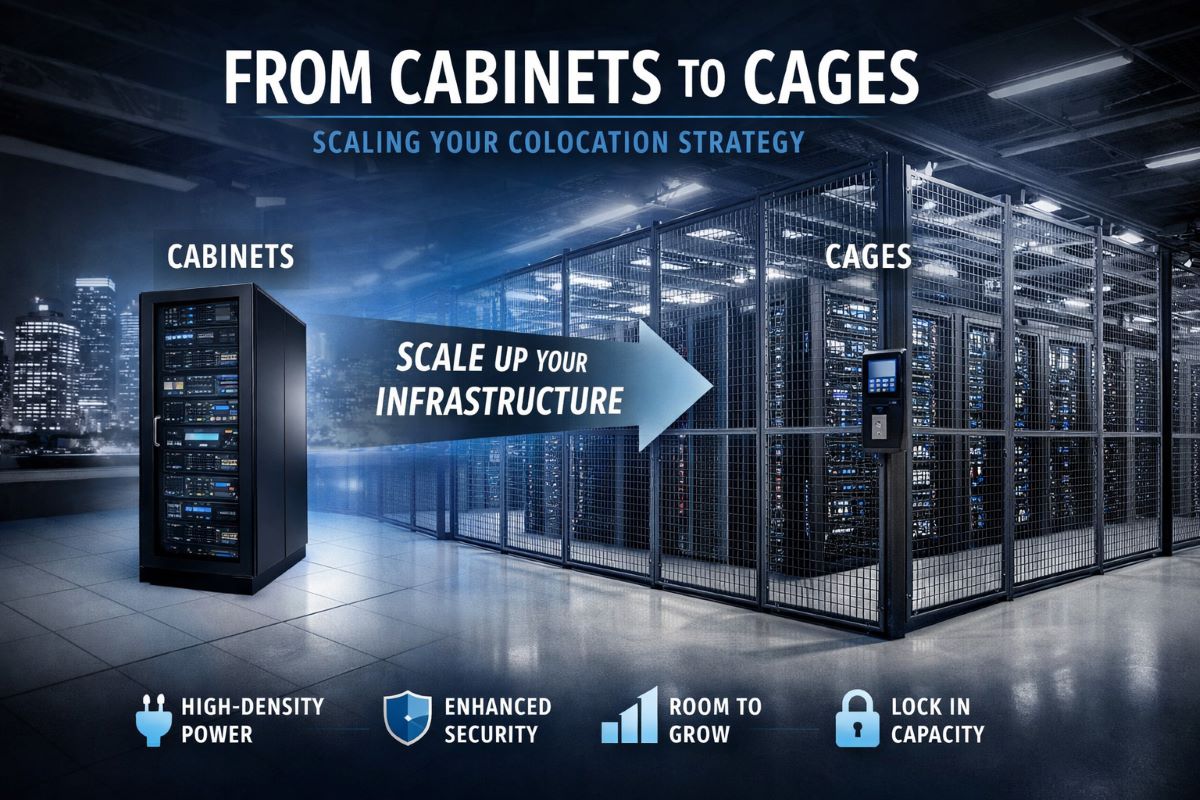
Growth rarely happens all at once. Most organizations begin with a single cabinet. Over time, infrastructure expands, power density increases and compliance requirements tighten. At some point, a secure colocation cage becomes the next logical step to support mission-critical infrastructure and plan for growth.
The question is no longer whether colocation makes sense, but whether your current footprint is designed to scale efficiently.
Cabinets are ideal when you:
For startups, branch deployments, or smaller workloads, cabinets offer a practical and efficient solution.
But infrastructure rarely stays small.
As deployments grow, spreading equipment across multiple shared cabinets can create operational inefficiencies:
A cage consolidates your environment into a contiguous, secure footprint, designed intentionally rather than assembled incrementally.
Modern workloads demand more power per rack than ever before:
As kilowatts per rack rise, you may require:
A cage environment gives you the flexibility to engineer for higher-density deployments without the limitations of shared cabinet rows.
Organizations in healthcare, finance, and other regulated industries often face increasing scrutiny around physical security and infrastructure controls.
A cage environment provides:
It offers stronger isolation than individual cabinets while remaining more scalable and cost-effective than a fully dedicated suite.
Cabinet-based expansion is often reactive, adding racks wherever space is available.
A cage allows you to:
Instead of solving for today’s footprint, you build for the next three to five years.
Data center capacity, especially power, has become increasingly competitive.
Rising demand from cloud adoption, AI workloads, and high-density deployments has tightened available space and utility allocation in many markets. Waiting until you urgently need additional racks may leave you competing for limited inventory.
Transitioning to a secure colocation cage environment allows you to:
This shift isn’t just operational, it’s strategic. Locking in space and power today ensures your infrastructure can grow without disruption tomorrow.
| Feature | Cabinet | Cage |
| Physical isolation | Per cabinet | Fully enclosed environment |
| Scalability | Limited | High |
| Custom power configuration | Moderate | Extensive |
| Layout flexibility | Minimal | Full design control |
| Growth planning | Reactive | Strategic |
| Ideal for | 1–3 racks | 3–20+ racks |
For organizations with highly specialized compliance requirements or extreme isolation needs, a dedicated private suite may be appropriate.
However, for most expanding deployments, a properly designed cage delivers the security, performance, and scalability required, without overcommitting to more space than necessary.
A cage often represents the most balanced and efficient path forward.
Colocation decisions should not only solve immediate requirements, they should support future infrastructure strategy.
If you are:
It may be time to move from cabinets to a secure cage environment.
Scaling your colocation footprint isn’t just about space. It’s about securing power, protecting growth, and ensuring your infrastructure is engineered for what comes next. Request a consultation with Datotel.