
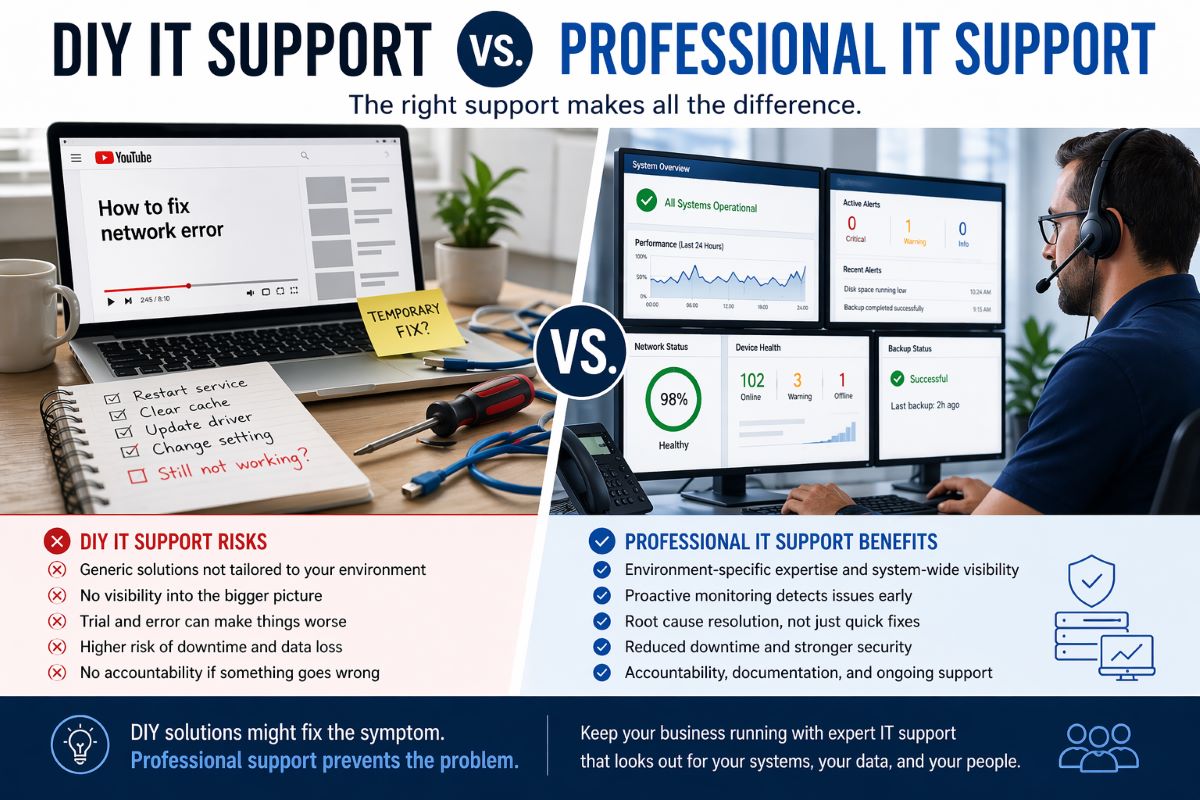
Most IT problems don’t start as emergencies. Instead, they begin with a quick search, a YouTube video, or a forum thread promising a simple fix. This is where the difference between DIY IT support vs professional IT support becomes important, especially when quick solutions begin to scale across business systems.
“Restart this service.”
“Clear this cache.”
“Run this command.”
At first, these solutions often work.
However, in business environments, the real question isn’t whether a fix works once, it’s what happens next. When systems connect and users depend on uptime, even a small change can affect multiple systems.
That’s where the difference between DIY IT support vs professional IT support becomes clear.
Businesses often choose DIY IT troubleshooting because it feels fast and accessible.
For example, YouTube tutorials and forums:
As a result, teams can resolve small, isolated issues quickly.
However, business IT environments rarely stay isolated for long. As systems grow, dependencies increase, and risks become less visible.
Hidden system dependencies
Modern IT systems connect in ways that aren’t always obvious.
For instance, a simple change might affect:
Because of this, a quick fix may solve one issue while creating another.
Temporary fixes that create recurring problems
DIY troubleshooting often focuses on symptoms instead of root causes.
As a result:
Eventually, the issue returns, often with greater impact. In many cases, repeated quick fixes make the problem harder to diagnose later.
Lack of system-wide visibility
YouTube tutorials focus on one device or one error.
In contrast, business IT environments operate across:
Without full visibility, teams cannot accurately evaluate how a change affects the broader environment.
Risk of downtime and data loss
Most DIY fixes do not include safeguards.
For example, they rarely involve:
Because of this, even small changes can lead to downtime or data loss. In business settings, that risk carries real operational and financial consequences.
Professional IT support changes how teams approach problems, not just how they fix them.
Monitoring and proactive detection
Instead of waiting for issues, IT teams monitor systems continuously.
As a result:
Controlled change management
Professional teams handle changes carefully.
Before making updates, they:
Because of this, they prevent unintended consequences and maintain system stability.
Escalation to specialized engineers
Not all IT problems require the same expertise.
Therefore, support teams escalate issues to the right specialists, such as:
This ensures that each issue receives the appropriate level of attention and expertise.
Business continuity and risk reduction
Ultimately, professional IT support focuses on long-term stability.
As a result, businesses:
| Area | DIY IT Support (YouTube / Self-Service) | Professional IT Support |
| Speed | Immediate | Structured response |
| Knowledge scope | Generic | Environment-specific |
| Risk control | Minimal | Managed and planned |
| Visibility | Limited | System-wide |
| Fix quality | Often temporary | Root-cause focused |
| Accountability | None | Clearly defined |
| Business impact | Not considered | Primary focus |
DIY IT support still has a place in the right situations.
For example, it works well when:
In addition, DIY troubleshooting helps users build a basic understanding of systems and common issues.
However, as risk increases, DIY approaches become less reliable.
Businesses should rely on professional IT support when:
At this stage, structured support reduces uncertainty and prevents larger disruptions.
DIY IT support works well for simple problems. It provides fast and accessible solutions.
However, business environments require more than quick fixes. As systems become more complex, the risk of unintended consequences increases.
Therefore, organizations need structured, proactive, and accountable support.
YouTube can help fix a problem once. Professional IT support ensures it doesn’t come back
Reach out to us today to discuss how Datotel can help you with professional IT support.