
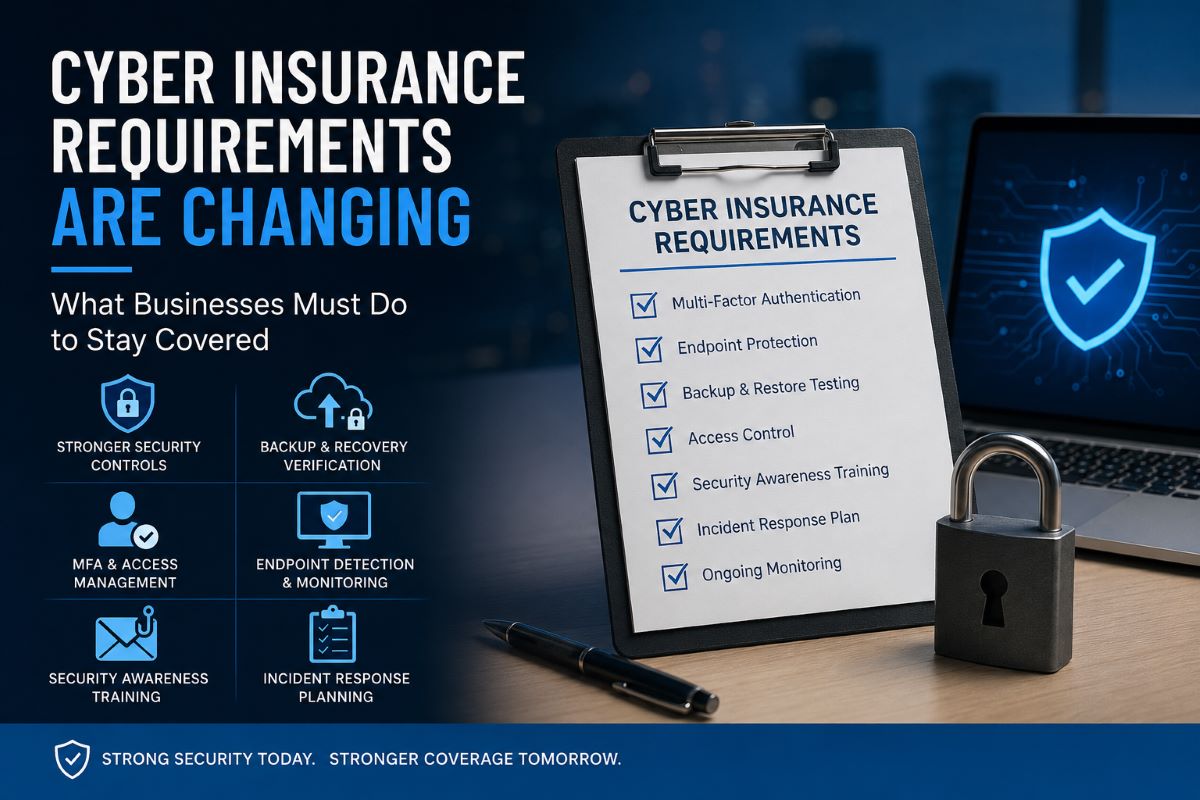
Cyber Insurance Requirements: How to Stay Covered

Cyber insurance is no longer a “check-the-box” policy. Over the past few years, cyber insurance requirements have fundamentally changed as insurers reassess how they evaluate risk. As a result, many businesses are discovering that their coverage is no longer guaranteed when they actually need it.

What used to be a relatively simple application has now become an ongoing security audit. In many cases, claims are being denied because companies did not meet evolving baseline requirements.

Here’s what is changing, and more importantly, what businesses need to do to keep coverage active.

1. Why cyber insurance requirements are tightening

Cyber insurers have been hit with massive losses from ransomware, business email compromise, and cloud account takeovers. Because of this, cyber insurance requirements are becoming significantly stricter.

Instead of asking:

  • “Do you have insurance?”

They are now asking:

  • “Can you prove you are actively reducing risk?”

As a result, underwriting is no longer based on intent alone. Instead, it is based on measurable security maturity.

2. MFA is no longer optional (and it must be enforced everywhere)

Nearly every modern policy now requires:

What’s changed

Previously, it was enough to say MFA was available. However, that is no longer acceptable.

Now:

  • “MFA available” is not enough
  • It must be enabled and enforced across all users

Common failure points

Many claims are denied because:

  • legacy accounts do not have MFA enabled
  • shared administrator logins are still in use
  • MFA is only partially deployed (for example, only executives are protected)

3. Backup requirements are becoming stricter, and more technical

Insurers are increasingly requiring proof of:

  • regular automated backups
  • offline or immutable backup storage
  • documented restore testing (not just backup success logs)

Why this matters

Although backups may exist, ransomware claims often fail because:

  • backups were also encrypted during the attack
  • restores were never tested in advance
  • recovery time exceeded acceptable business thresholds

What insurers now focus on

Instead of simply asking:

  • “Do you have backups?”

They are now asking:

  • “Can you restore critical systems within X hours?”

4. Endpoint protection and monitoring are now mandatory

Basic antivirus is no longer sufficient. Instead, most insurers now require:

What has changed

Insurers are now explicitly expecting:

  • behavior-based threat detection rather than signature-based antivirus
  • real-time detection and response capability

5. Privileged account control is under scrutiny

One of the fastest-growing underwriting requirements is control over administrative access.

As a result, insurers are asking:

  • How many admin accounts exist?
  • Are they individually assigned rather than shared?
  • Are they actively monitored and logged?

Key expectations now include:

  • least privilege access models
  • separation of admin and user accounts
  • logging of all privileged activity

6. Security awareness training is becoming a policy condition

Human error remains one of the leading causes of breaches. As a result, cyber insurance requirements now often include:

  • annual or quarterly phishing training
  • documented employee participation
  • simulated phishing exercises in some cases

Why this matters

If an employee clicks a phishing email that leads to a breach, insurers often evaluate:

  • whether training was current
  • whether it was enforced across the entire organization

7. Incident response planning is now required, not optional

More policies now require a documented incident response plan that includes:

  • internal escalation procedures
  • external vendor contacts (legal, IT, forensic)
  • a defined communication strategy

Critical shift

Insurers are increasingly asking:

“Do you have a tested incident response plan?”

Rather than simply:

“Do you have a plan?”

8. Cyber insurers are increasingly auditing renewals

A major change many businesses overlook is that coverage is no longer static.

At renewal, insurers may require:

  • updated security questionnaires
  • proof of MFA enforcement
  • evidence of backup testing
  • validation of endpoint protection

In some cases, they may:

  • increase premiums
  • reduce coverage limits
  • or decline renewal altogether

9. What happens if you don’t meet requirements

If an organization does not meet underwriting standards, several outcomes are possible.

For example:

  • policy non-renewal
  • significantly higher premiums
  • exclusions for ransomware events
  • denial of claims due to “failure to maintain security controls”

As a result, this situation is becoming increasingly common.

10. How businesses can prepare (practical checklist)

To remain insurable, most organizations should focus on the following areas:

Identity & access

  • MFA enforced everywhere
  • admin accounts separated
  • password manager adoption

Endpoint security

  • MDR/EDR deployed across all devices
  • centralized monitoring in place

Backup & recovery

  • immutable backups
  • quarterly restore testing
  • documented recovery objectives (RTO/RPO)

Training & policy

  • phishing training program
  • incident response plan
  • documented security policies

11. Where managed IT providers fit in

Most SMBs and mid-market organizations struggle not with understanding these requirements, but with consistently implementing and maintaining them.

Because of this, providers like Datotel typically support organizations by:

  • enforcing MFA across systems
  • continuously monitoring endpoints and threats
  • maintaining and testing backup integrity
  • documenting compliance-ready security controls
  • supporting incident response readiness

Ultimately, the key shift in cyber insurance is ongoing proof, not one-time setup.

Closing thought

Cyber insurance is becoming less about “insurance” and more about verified operational security discipline.

Companies that treat it as a checklist will continue to face rising premiums and tighter restrictions. However, companies that treat it as an ongoing program will not only maintain coverage but also significantly reduce real-world breach risk at the same time.

Contact Datotel to talk through how we can help you.