
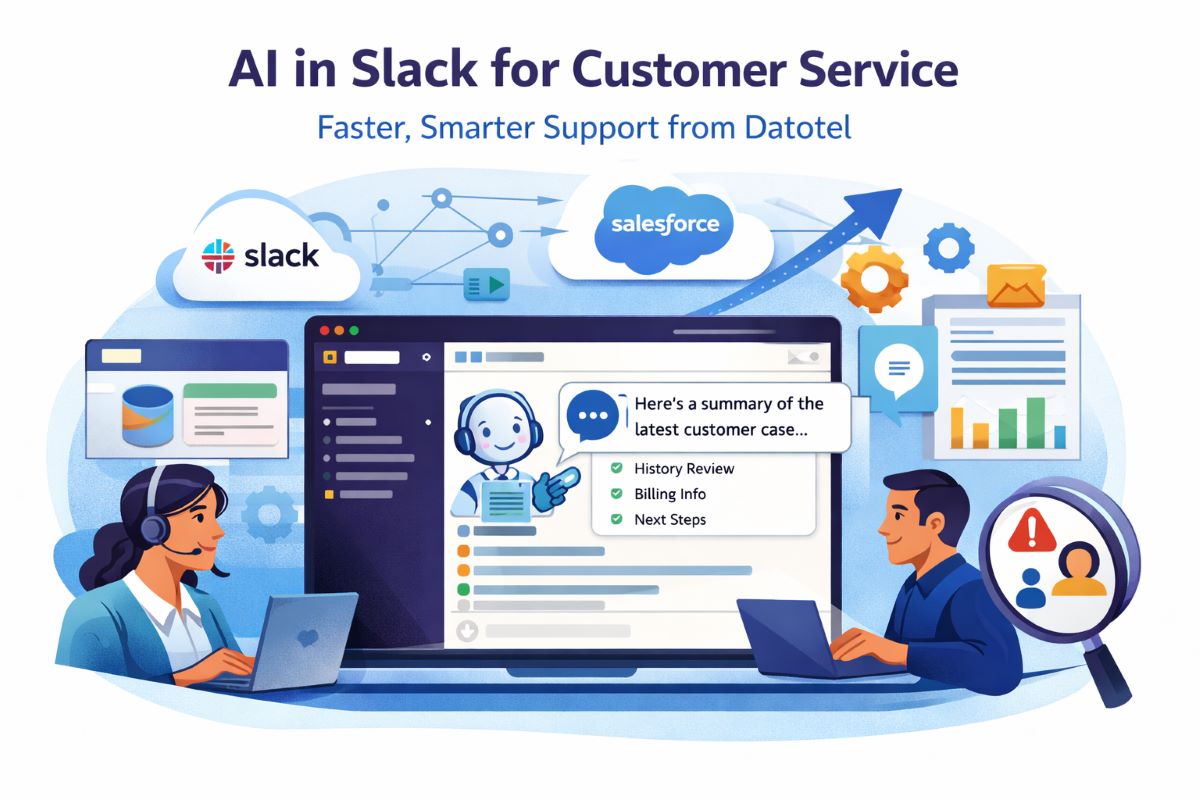
AI in Slack for customer service is transforming how teams operate, because customers expect fast answers, accurate information, and seamless communication. However, many teams still struggle to meet those expectations, especially when service, sales, and finance are working in separate systems.
As a result, information often becomes scattered across tools, and agents spend too much time searching instead of solving. In contrast, customers are left waiting, repeating themselves, or dealing with disconnected communication.
That’s where AI in Slack for customer service changes the game. At Datotel, we use Slack alongside Salesforce Service Cloud to help teams collaborate in real time. In addition, this approach allows teams to surface the right information instantly and resolve customer issues faster.
AI inside Slack isn’t just a chatbot. Instead, it acts as a context-aware assistant that helps teams operate more efficiently across several key areas.
Access and Connect Information
First, AI helps pull information from multiple sources. For example, it can surface data from Salesforce and internal conversations in Slack. As a result, teams don’t need to switch between systems.
Summarize and Organize Context
In addition, AI can summarize customer history, past cases, and ongoing conversations. Therefore, agents can quickly understand the full situation without searching manually.
Support Communication and Escalations
AI also helps draft responses and escalation summaries. Consequently, teams can communicate more clearly and consistently with customers and internal stakeholders.
Identify Patterns and Trends
Furthermore, AI can analyze support activity to identify recurring issues. This allows teams to act proactively rather than reactively.
Connect Service, Sales, and Finance
Finally, AI helps bring service, sales, and finance into one place. Because of this, teams operate with shared context and better alignment. Instead of switching between systems, teams work in one centralized space, with AI guiding the process. As a result, they can focus more on solving problems and less on searching for answers.
At Datotel, AI in Slack isn’t just a tool, it’s part of how we operate across teams. Because of this, our service, sales and finance teams stay aligned and responsive at every step.
Here’s how it shows up in real customer scenarios:
1. Faster Resolution Without Repeating the Same Information
When a customer reports an issue, our team doesn’t start from scratch. Instead, we use AI to quickly gather full context.
Behind the scenes, we use AI to ask:
“Summarize this customer’s recent cases, system activity, and any related conversations in Slack.”
This allows our team to:
Customer impact: Faster resolution and a smoother support experience.
2. Smarter Handling of Billing and Account Questions
Billing issues often require input from both service and finance teams. Therefore, coordination is critical.
Instead of escalating manually, we use AI to:
“Summarize contract terms, recent invoices, and any prior billing discussions.”
This allows our team to:
Customer impact: Clear, fast answers without unnecessary delays.
3. More Prepared and Consistent Customer Communication
For high-priority issues, preparation matters. In fact, it can define the entire customer experience.
Before customer calls or escalations, we use AI to:
“Generate talking points based on recent issues, account history, and prior communications.”
This ensures:
Customer impact: Confidence that your partner is fully aligned.
4. Proactive Support Instead of Reactive Escalations
AI helps us identify patterns across customer activity and support cases. Because of this we can act before issues escalate.
For instance, we use prompts like:
“Identify customers with repeated issues and upcoming renewals or key milestones.”
This allows our team to:
Customer impact: Fewer disruptions and a more reliable experience.
5. Continuous Improvement of Support and Documentation
Great service improves over time. Therefore, we use AI to continuously refine how we support customers.
We use AI to analyze:
“What questions are coming up most frequently that aren’t covered in our documentation?”
This helps us:
Customer impact: Better support today, and even better support tomorrow.
6. Clear, Complete Case Summaries Every Time
After resolving an issue, communication shouldn’t stop. Instead, it should reinforce clarity and trust.
We use AI to generate:
“A summary including timeline, impact, resolution, and key takeaways.”
This ensures:
Customer impact: Confidence in how issues are handled and resolved.
When AI is embedded inside Slack, it creates a unified way for teams to work together. In contrasts to traditional workflows, this eliminates fragmentation.
Instead of:
Teams can:
This directly improves key metrics like:
At Datotel, we don’t just support customer service, we deliver it directly to our customers using a modern, connected approach.
By combining:
We power our own service and support operations with greater speed, accuracy, and consistency.
As a result, our customers benefit from faster response times, more informed interactions, and seamless communication across every touchpoint. Instead of relying on disconnected systems, our teams work together in real time, with AI guiding decisions and surfacing the right information when it matters most.
Ultimately, this allows us to provide not just support, but a more proactive, reliable, and high-quality customer experience.
Ultimately, AI in Slack for customer service isn’t just about automation, it’s about alignment.
When service, sales, and finance operate together in real time, customers experience:
And today, that’s not a bonus, it’s the expectation.