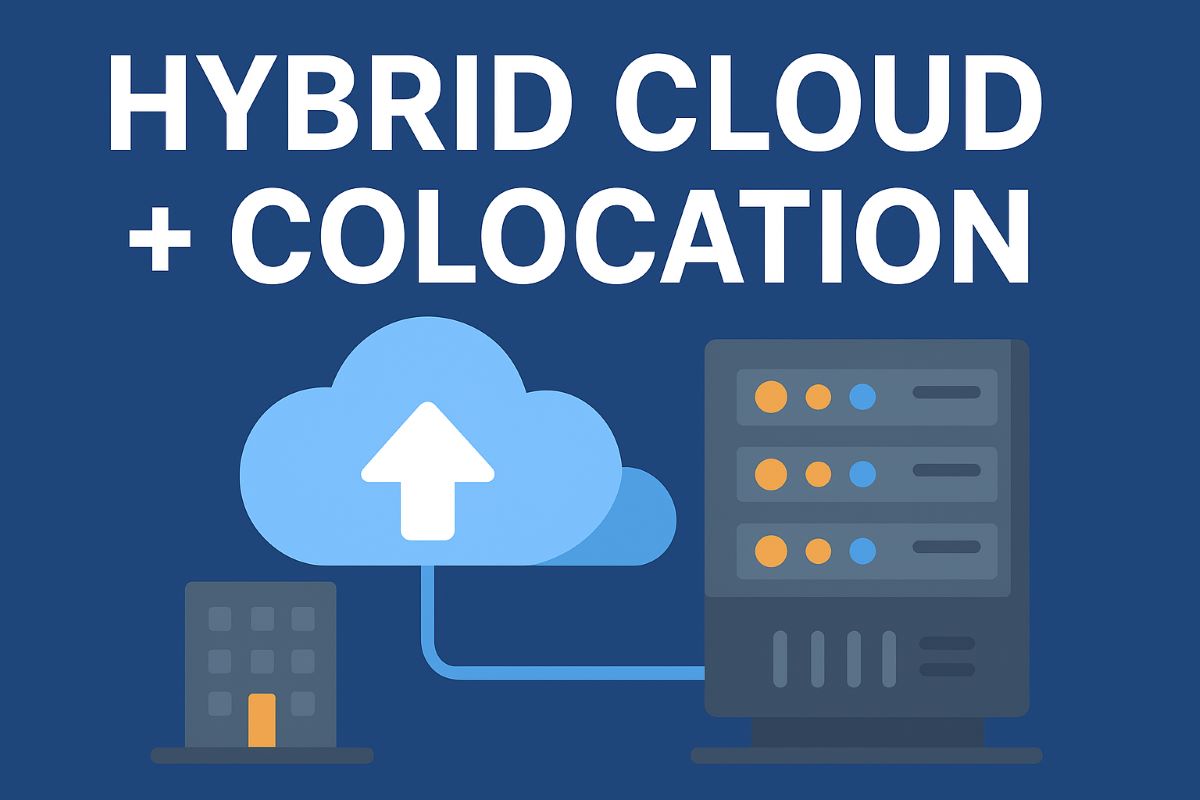
Hybrid Cloud + Colocation: Pros, Cons, and When to Use What
Home
/
Articles
/
Hybrid Cloud + Colocation: Pros, Cons, and When to Use What
Modern businesses face an ever-growing need for flexible, reliable, and secure IT infrastructure. With options ranging from public cloud services to on-premises servers and colocation facilities, choosing the right mix can be overwhelming. A hybrid cloud + colocation strategy offers a balanced approach, combining the agility of the cloud with the control and predictability of colocated infrastructure.
In this article, we’ll explore what hybrid cloud + colocation means, its advantages and challenges, and provide guidance on when each approach makes the most sense for your business.
What Is Hybrid Cloud + Colocation?
A hybrid cloud environment combines private infrastructure, either on-premises or in a colocation facility, with public cloud services.
Colocation involves housing your own servers and networking equipment in a third-party data center. You maintain full control over hardware, security, and configuration, while the provider handles power, cooling, and physical security.
Public cloud enables access to virtualized computing resources on-demand without managing physical infrastructure.
When integrated, hybrid cloud + colocation allows organizations to:
Maintain control over critical workloads and sensitive data
Leverage cloud elasticity for variable workloads
Achieve higher reliability, performance, and disaster recovery capabilities
Pros of Hybrid Cloud + Colocation
Balanced Flexibility and Control Colocated infrastructure gives you full control over servers, hardware, and networking, allowing precise configuration for specific workloads. Meanwhile, the hybrid cloud provides elasticity, enabling rapid scaling during peak demand without overprovisioning physical hardware.
Predictable Performance and Compliance For workloads requiring consistent performance, such as databases, legacy applications, or high-performance computing, or strict regulatory compliance (HIPAA, PCI, SOC 2), colocation ensures reliability. Non-critical or variable workloads can reside in the public cloud, optimizing resource usage.
Cost Optimization While public cloud offers pay-as-you-go convenience, long-term, steady workloads are often more cost-effective on colocated servers. Hybrid cloud allows businesses to match workloads to the most appropriate environment, balancing CAPEX and OPEX effectively.
Enhanced Business Continuity Hybrid strategies improve resilience and redundancy. Mission-critical applications can run on colocation servers, while cloud backups or failover capabilities safeguard against downtime or disasters.
Scalability and Future-Proofing Organizations can maintain control over existing workloads while leveraging the cloud for expansion, experimentation, or seasonal spikes, enabling scalable IT architecture without massive upfront investments.
Cons and Challenges of Hybrid Cloud + Colocation
Increased Complexity Managing both colocation and cloud environments adds complexity. IT teams must oversee multiple platforms, networks, and monitoring systems. Misconfigurations can impact performance, security, or compliance.
Upfront Costs and Maintenance Colocation requires hardware investment and ongoing maintenance, including software updates, licensing, and staffing. Scaling physical infrastructure is slower than the near-instant expansion offered by cloud services.
Integration and Latency Concerns Hybrid workloads need careful planning to avoid latency, bandwidth bottlenecks, and synchronization issues. Poor integration between cloud and colocated systems can reduce efficiency or even cause downtime.
Operational Overhead Monitoring, patching, and securing two environments increases operational load. Organizations without experienced IT teams may need managed services to ensure success.
Hidden or Mixed Costs Combining cloud OPEX with colocation CAPEX can create budgeting challenges if not carefully managed.
When to Use Each Approach
Business Need
Recommended Approach
Unpredictable or bursty workloads (startups, dev/test environments)
Public Cloud – scalable, on-demand, low upfront cost
Stable, high-performance workloads with compliance requirements
Key Considerations Before Adopting Hybrid Cloud + Colocation
Workload Assessment: Identify critical, low-latency, and elastic applications.
Expertise and Management: Determine if your team can manage a hybrid environment or if managed services are needed.
Total Cost of Ownership: Evaluate both CAPEX (hardware) and OPEX (cloud usage, staffing, network costs).
Security and Compliance: Plan for encryption, monitoring, access control, and compliance across both environments, incorporating principles like Zero Trust wherever possible.
Network Design: Ensure fast, reliable connectivity between colocated servers and cloud resources.
Workload Allocation Strategy: Define which workloads go where and establish clear policies for movement and failover.
Conclusion
Hybrid cloud + colocation is a strategic middle path, combining the control and performance of dedicated infrastructure with the flexibility and scalability of the cloud. It is particularly suited for organizations with mixed workloads, compliance requirements, or a need for resilient, high-performance IT environments. Success requires careful planning, workload analysis, and skilled management. With the right strategy, hybrid cloud + colocation enables businesses to enjoy the best of both worlds: reliability, security, and agility, without compromise.
Ready to optimize your IT infrastructure with the perfect balance of control, performance, and scalability? Explore Datotel’s Hybrid Cloud + Colocation solutions today and see how we can help your business achieve reliable, secure, and flexible IT operations. Contact us now to schedule a consultation or request a custom solution tailored to your needs.