
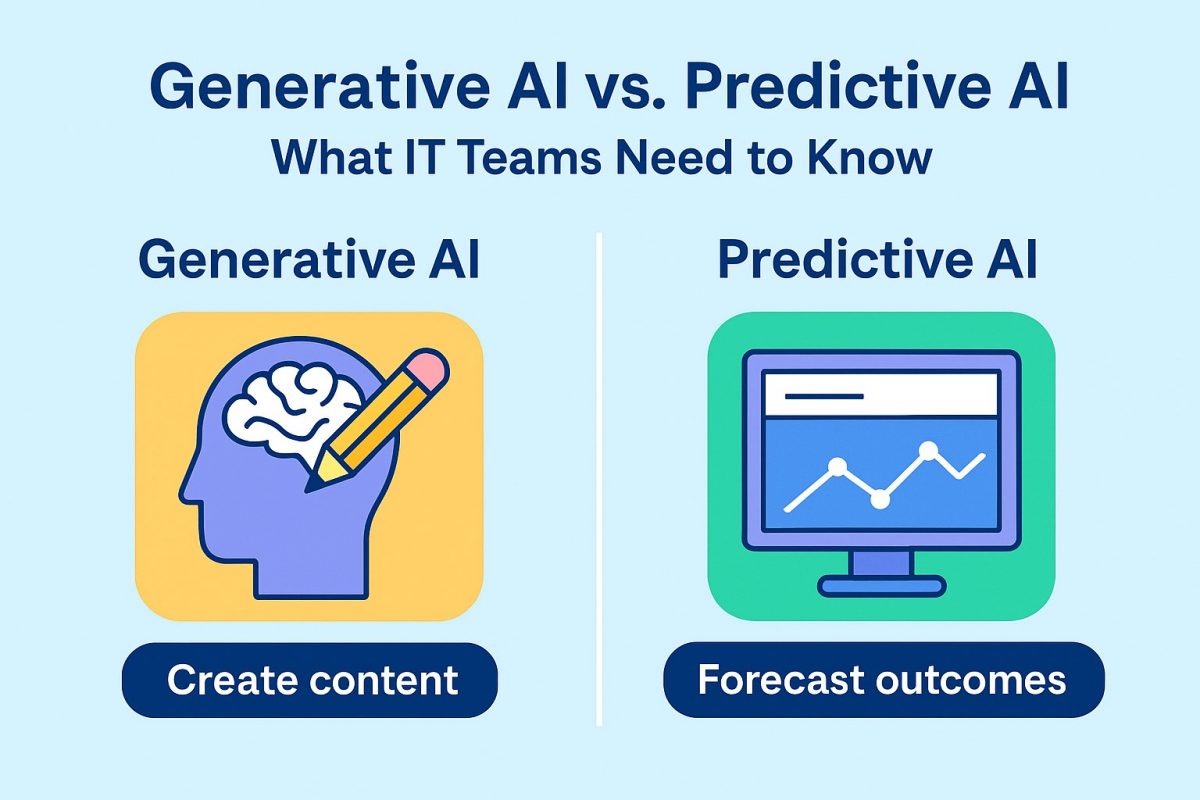
AI is everywhere these days, from chatbots helping you reset passwords to systems that prevent server crashes. But not all AI is the same. In fact, two types dominate today’s IT support conversations: predictive AI vs. generative AI. Knowing the difference can save your team time, money, and headaches.
Think of predictive AI as a forecasting tool. It looks at historical data to predict what might happen next.
How IT teams use it:
Bottom line: Predictive AI is all about seeing problems before they happen so your IT environment stays healthy.
Generative AI is more like a smart helper. It doesn’t just predict, it creates. Think draft emails, knowledge articles, or even code snippets.
How IT teams use it:
Bottom line: Generative AI produces content or solutions that assist humans, making IT support faster and more scalable.
| Feature | Predictive AI | Generative AI |
| Purpose | Forecast issues | Create content or solutions |
| Input | Logs, historical data | Knowledge bases, manuals |
| Output | Alerts, risk scores | Draft messages, guides, scripts |
| IT Use Cases | Monitoring, case prioritization | Chatbots, auto-responses, documentation |
| Role | Proactive problem prevention | Supports humans with creative outputs |
In IT support and managed services, both types of AI are powerful, but in different ways. Predictive AI is your safety net, preventing issues before they hit. Generative AI is your productivity booster, helping your team work smarter, not harder.
By understanding when to use Predictive AI vs. Generative AI in IT Support and how they can be applied, your IT operations can become proactive, efficient, and scalable, keeping users happy and systems running smoothly.